Image
Photographer
Scan

8082
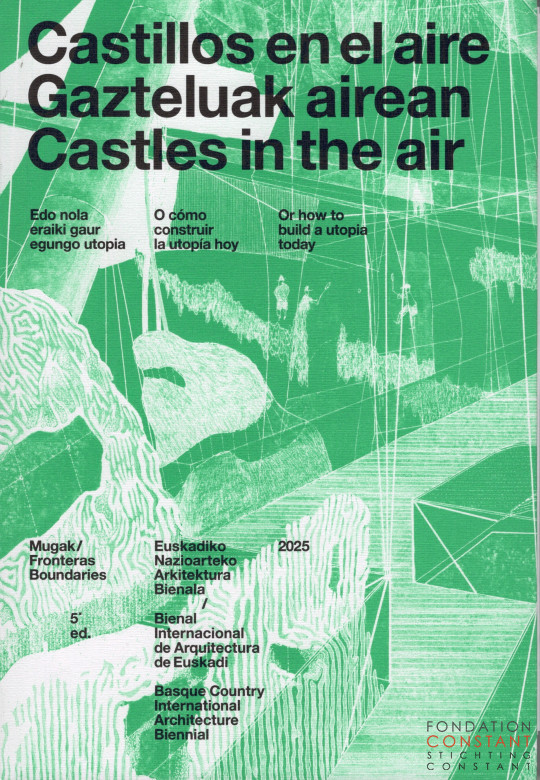
Eu-topias, Ou-topias is the title of the main exhibition of Castles in the air, or, how to build utopia today, the 5th Mugak Biennal.
The Boundaries Basque Country International Architecture Biennial fifth edition in 2025 will be held from 9 October to 14 November, consolidating its position as one of the main architectural events in Atlan-tic Europe. As in previous editions, the three Basque capitals will host an extensive pro-gramme with the purpose of sharing spaces for reflection and collective experimentation.
In 1516, Thomas More published Utopia, the book in which the term was mentioned for the first time, destined to mark the political imagination of subsequent centuries. When coining the term, More was playing with a double meaning: eutopia, the “good place”, and outopia, the “no place”. This tension allows a horizon to open up in which the desire for a better world is intertwined with the impossibility of pinpointing it on a map.
In Constant's New Babylon, Juan Pro revisits this duality and presents it as the very core of utopian impulse: the projection of a better place that, precisely because it does not exist, becomes the driving force of imagination and change.
This idea connects with the historical journey traced by Lewis Mumford in The Story
of Utopias, where he states that the story of utopias is, in a certain sense, the story of the world. According to Mumford, many utopias are born as a rejection of the social and cultural contexts of their time and they manifest as one of two main types: escape utopias, which flee from reality, and regenerative utopias, which seek to transform it. Furthermore, he warns of the dangerous proximity between dystopia and a realised utopia: when the ideal is embodied, it runs the risk of degenerating into its opposite.
Nowadays, utopias seem to have fallen into disrepute. Dominant pragmatism limits the space to imagine better futures, and dystopia has become the norm in our realities. However, utopia remains a critical and powerful tool, capable of inspiring transformations, motivating social change, and offering a space of experimentation for architecture.
We must not forget the dangers that exist in a time that is not very open to utopianism. As Paul Ricœur recalled, a society without utopia is a society without purpose. Therefore, in the face of dystopian resignation, utopia remains a vital exercise: a non-place from which to imagine better futures.
| Title | Year |
|---|---|
| Castles in the Sky | 2025 |
No related items available
No related items available
No related items available
No related items available
| Title | Year |
|---|---|
| Plattegrond Deurenlabyrint | 1974 |
| Schets voor een sector met een tentdak | 1964 |
| Schets voor zelfdragende constructie | 1964 |
| Labyr | 1962 |
| Mobiele wanden | 1960 |
| Grundriss New Babylon über Slotermeer | 1958 |
No related items available
No related items available