Image
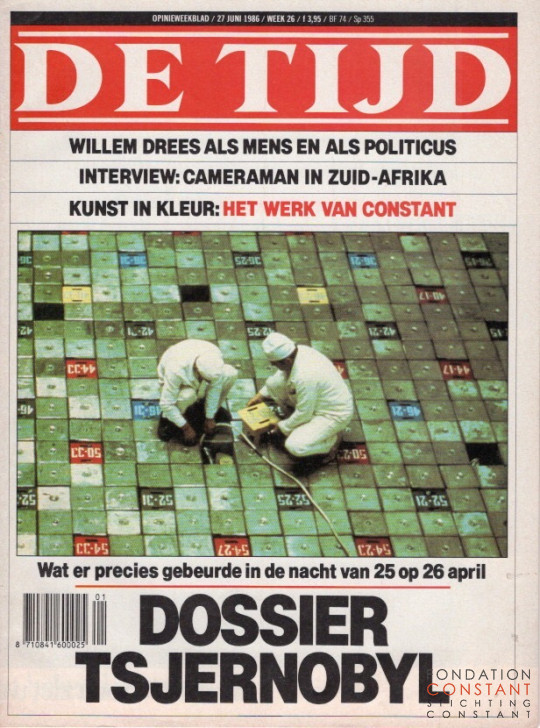
Photographer
Scan Kim

8166
The article portrays Constant Nieuwenhuys as an unusually intellectual yet deeply intuitive painter. Although he wrote manifestos and played a leading ideological role in Cobra and the Situationist movement, he insists that the act of painting ultimately escapes conscious control: the image seems to make itself, and he only interprets it afterwards.
Constant admired painters such as Titian, Rubens, Delacroix and especially Cézanne. From Cézanne he drew the idea that colour, rather than conventional perspective, creates depth and life. He rejected much modern art because he felt it had become subordinate to walls and architecture, decorative rather than autonomous. The elaborate frames around his paintings make this position literal: they separate the painting from its surroundings.
His political and artistic past remains important. After his Cobra years, he developed New Babylon, a visionary environment for a future society freed from labour. When he returned to painting, encouraged by Fanny Kelk, his work became increasingly shaped by personal experience, especially after her death in 1978. He works slowly and painstakingly, sometimes destroying a canvas after months of work.
The “double layers” of the paintings
The article’s central idea is that Constant’s later paintings support several meanings at once. They are autobiographical, but not straightforwardly illustrative; personal memories, literary references, political violence, love, grief, music and art history overlap.
The article concludes that Constant is neither a traditionalist nor a painter of simple political messages. Major events of the twentieth century enter his work indirectly, transformed by memory and imagination. His paintings remain deliberately ambiguous: visually rich, emotionally charged and full of “double bottoms” that prevent any single final interpretation.
No related items available
No related items available
No related items available
No related items available
No related items available
| Title | Year |
|---|---|
| La Samaritaine | 1984 |
| l'Interrogatoire | 1983 |
| L'exécution | 1982 |
| Nostalgia | 1982 |
| Orpheus [I] | 1981 |
| De dompteuse | 1980 |
| l'Ultima cena | 1979 |
| Overreden hond | 1977 |
| Cyrano déclare son amour | 1976 |
| Plaisir et tristesse de l'amour | 1976 |
No related items available
No related items available